
Patient Story
Just Breathe.
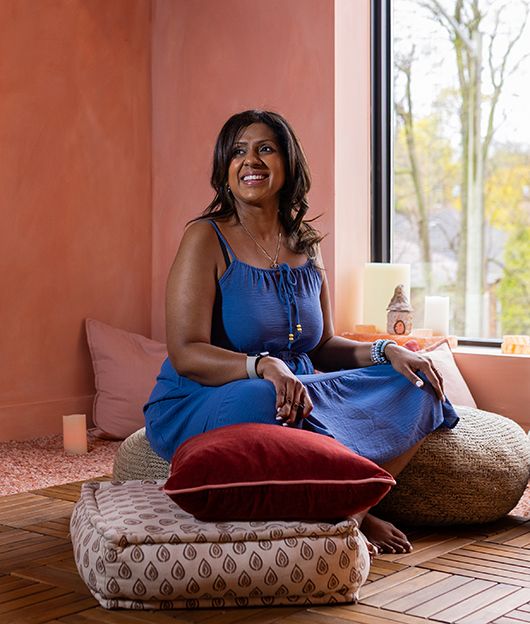
As a breathwork coach, Reshma teaches how adjusting your breathing can help manage stress, regulate emotions, find clarity, and support overall health.
Just breathe. It’s not just a familiar mantra. It’s also what Reshma had to tell herself, over and over, as she quickly realized she was having a stroke.
This August marks four years since Reshma’s life changed forever.
At that time, Reshma had built a 12-year career in banking, working as a business analyst and project manager. Outside of her professional career, yoga and breathwork became a deep personal passion — eventually leading her to become a trained yoga teacher and breath coach.
Just over three years ago, in the middle of teaching a yoga class, Reshma suddenly couldn’t move.
“It was my first big class. I was a little nervous and excited. Suddenly my head felt funny and I couldn’t move,” Reshma recalls. “I couldn’t get up off the floor, and one of the students had to call 911.”
In those frightening moments, Reshma’s thoughts were everywhere:
…What’s happening to me?
…I’m too young!
…What about my boys?
The memory is foggy, but at just 42 years old, she remembers one of the paramedics saying, “You’ve had a stroke.”
Reshma was rushed to the Emergency Department in Oshawa and met with a flurry of action and an expert team at the ready—a neurologist, nurses, physicians, technologists, and more—all dedicated to diagnosing and treating her. As the hub for emergency stroke care, hospital staff are alerted when a stroke patient is minutes away from arrival so the CT machine can be ready for an immediate scan.
In the moments following a stroke, a staggering 1.9 million brain cells die every minute an artery is blocked. The first four hours are critical.
Thanks to the swift work of the team, Reshma was given a clot-busting drug to stop her stroke in its tracks and minimize its impact on her life.
“I recall waking up and knowing my family was visiting, but I wasn’t aware of everything that had helped get me to that point in the Integrated Stroke Unit at Lakeridge Health.”
From that moment onward, Reshma’s focus was on getting better and returning home to her two sons.
Filled with gratitude, Reshma has a deep appreciation for the staff in the unit. “For weeks, they helped me regain my ability to walk—first with a few steps down the hall, then outside in the park. The therapists give their whole heart, and I felt so comfortable with them. I knew they would help make things better.”
Today, Reshma is rebuilding her life and embracing her new normal. She keeps busy with her boys, aged six and eight, and she’s getting back into wellness and breathwork courses.
“I still have my challenges. Many stroke survivors feel the same way—our deficits can be invisible. I struggle with my hand at times and need a special driving aid. I arrive early everywhere I go so I can take my time and find the best route. Sure, it’s not easy, but it’s also a reminder of what I’ve overcome.”
Being part of a campaign that supports the Regional Stroke Program at Lakeridge Health means Reshma can help raise awareness—and funds—for stroke survivors like her.
“When you make a donation, you’re helping someone come through one of the darkest times in their life. I’m thankful I was in the right place with the right people. And this campaign means the right equipment will be available too.”